My Introduction to RPS
About two years ago, I received an invitation to consider becoming a reflective pastoral supervisor. At the time, I was mentoring a group of pastors who had just completed their third year of mentorship, which is a requirement of first year pastors in the ELCA. At first glance, it seemed like a type of coaching style using art and play. My doctorate was on using play to address trauma, so it seemed right up my alley. I wanted to give it a shot though before committing, so I asked about connecting with a supervisor.
Due to the distance, the supervision was done via Zoom and I knew I was helping someone who was in training, so it would be an opportunity to watch the progress unfold from someone still learning how to do it herself. I knew I had to bring an issue into the session, so I brought a situation I was currently struggling with in my congregation.
After the introductions and the small talk, I was asked the question- how would you like to acknowledge God in our session today? It was at this moment, that I knew this was different from a coaching session, as coaching rarely talks about God. Spiritual direction did, but one didn’t often wrestle with congregational issues in spiritual direction. I was having difficulty, after the first question, as to what kind of category did this fit into. I already had the process explained to me, but experiencing it was very different with just the first question.
As I explained the situation and what I was wrestling with, I expected my first series of questions, still thinking this was coaching. Instead, I was asked to place my situation in the form of a question. What exactly did I want this session to be about and how was it connecting to me at this moment in my ministry. Coaching doesn’t ask the client to create their own questions. Once again, I was left wondering what this was.
I don’t want to give the exact wording of the question, as I am currently serving the congregation, but it was around the idea of working with different personalities that can exist in a congregation. “How can I work with such and such of a personality?” The follow up was, “how would you like to explore this question?” Again, I am sitting there stumped and did not know what that question meant. Finally, I gave in to the process without trying to fit it into a coaching or spiritual direction box. It was its own thing.
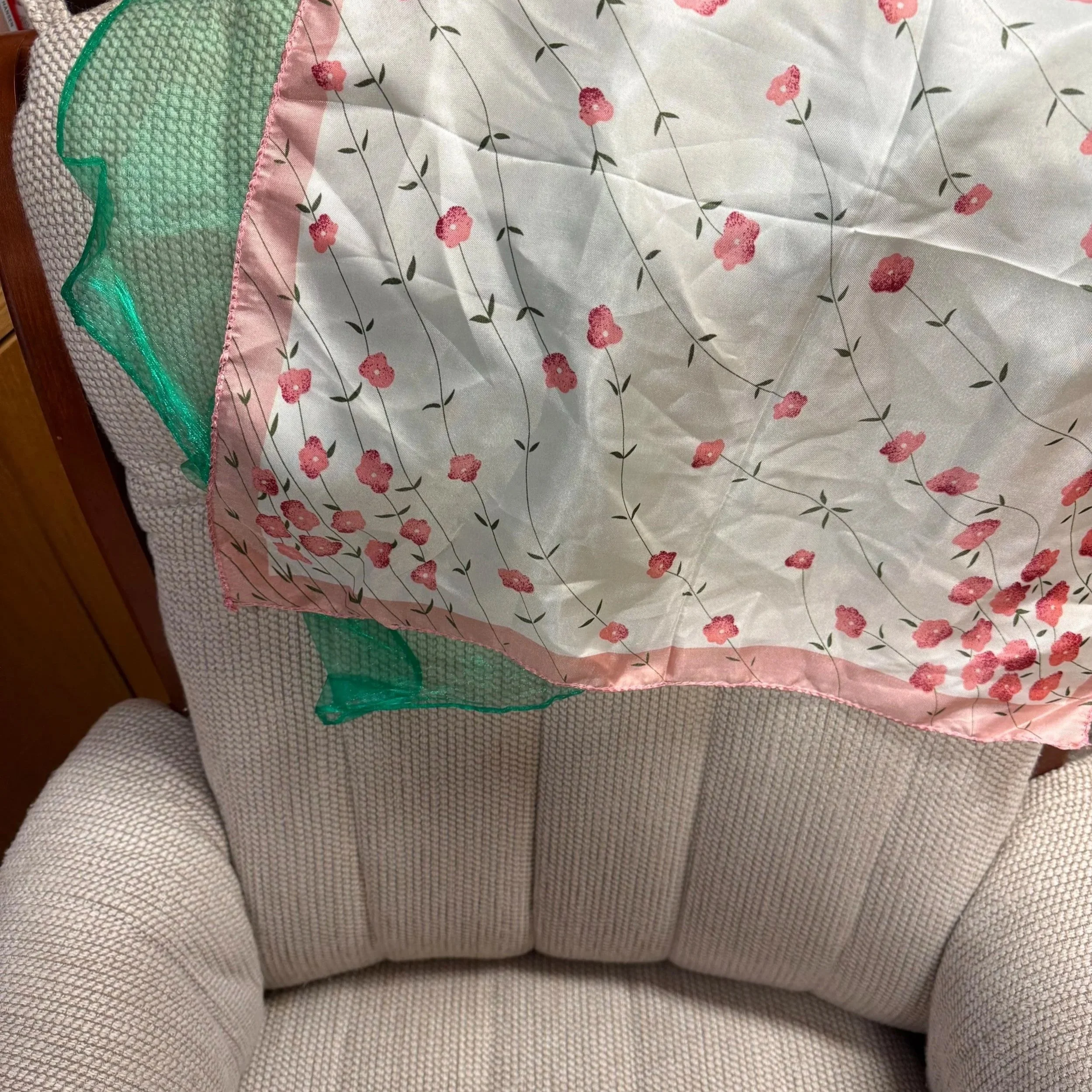
An image of a chair with some fabric on it. This is an embodiment practice.
“Ok, what I would like you to do is find some fabric to make a stage,” my supervisor invited me to begin. I looked around the room for some fabrics I had lying around and grabbed a green juggling fabric and a flowery scarf. They had little to do with the scene and more to do with the idea these were the only fabrics I had near me and I still wasn’t sure about the process.
I was then invited to select three items around the room that represented the personality I was working with. I was then invited to select three items that represented me. As I described the items, I heard myself sharing a vision of who I was as a leader and my care for the personality in question. The objects I selected were intentional and came to represent the two people in the scenario, even though one of the two people was me. I started talking about myself objectively, naming how I added to things or expectations I had or how I needed to step in and step out. If you are familiar with adaptive leadership, what I was being invited to do was take a balcony view of the situation, but it wasn’t just in my head. What was different is after I selected the six objects, I was invited to place them onto the stage I had laid out and place them in relationship to one another. Here I was literally looking at what my head wanted to dictate and was talking objectively about the whole situation, while sticking with the question I had created earlier.
I could go on with a summary of the whole session, but to make the story shorter, by removing being in the actual situation, I saw a wider view of the WHOLE situation. We get caught up in leaders where we only look at what other people are doing and not at what we ourselves are doing. This process included me and my actions. I couldn’t remove myself and I saw how I was contributing to the personality conflict.
Then the question of God came in as well. Where is God working in this situation? Again, my supervisor wanted me to see God working, not only in my ministry, but in the other person, and in the whole situation. It was a reminder that God is still an active part of every interaction in ministry and not just the preaching or Bible study parts. The parts we relegate God into. God was part of everything!
We ended in prayer, once again thanking God for working in everything. It wasn’t coaching. It wasn’t spiritual direction. It was a look at the mix of the Spirit and leadership in everything. That was what RPS was for me.
